
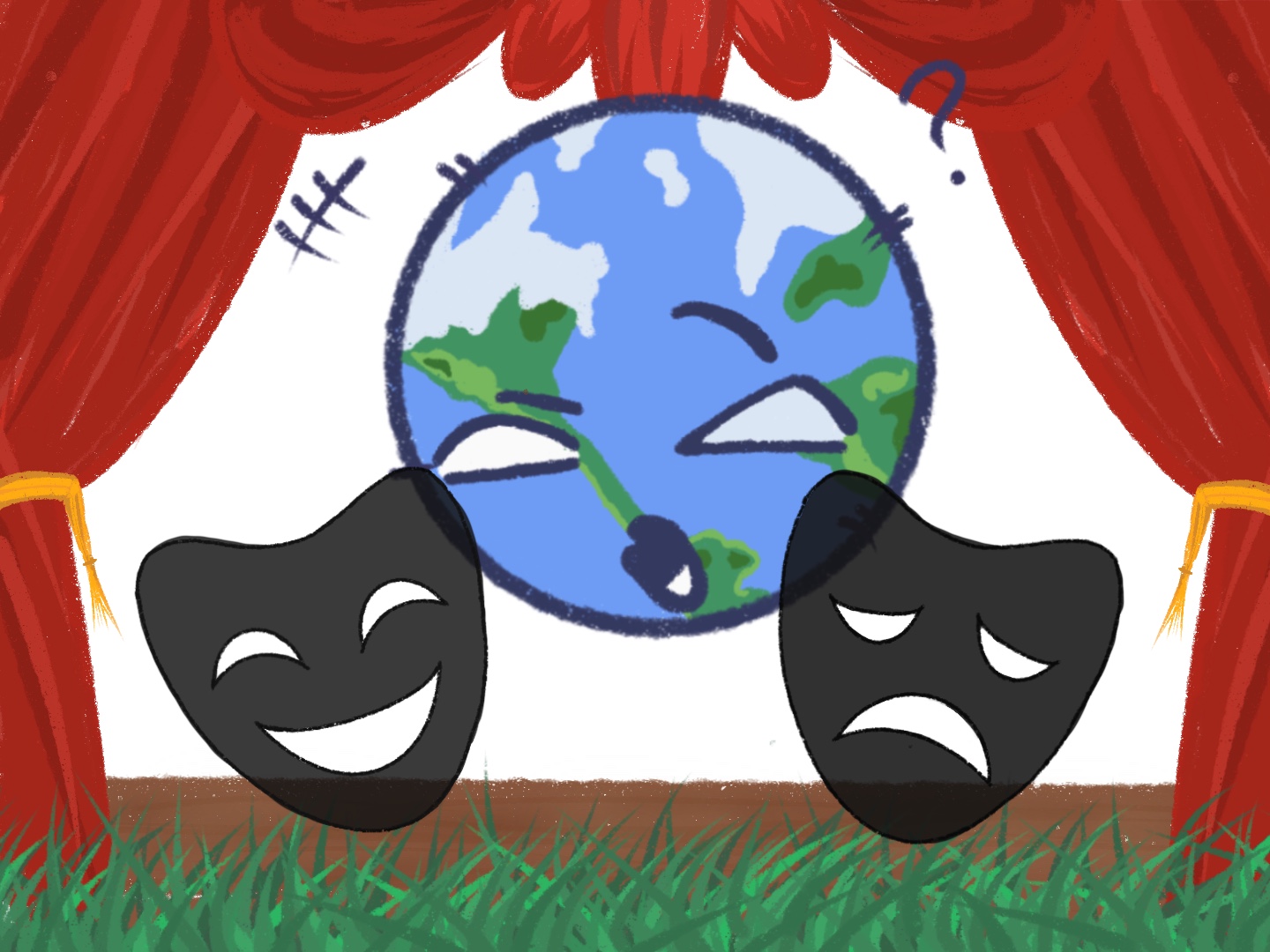
Illustration Angelina Lanno
The earth community is made up of different individuals and groups. We do not all live in the same conditions, we are not equally responsible for the state of the planet. Environmental hazards threaten us unevenly. Our relationship with the Earth varies and evolves based on the current climate, our experience of the natural world, our distance from and dependence on the nearest factory, the state of the planet same as our favourite forest. Identity, religion, way of life plays a role, and one could go on and on. But what is certain is that we are all interdependent and each of us experiences this complicated relationship in some way. Theatre makers and artists are aware of this and are increasingly focusing on 'nature'. And Ecodramaturgy is the term that is supposed to cover the whole existing practice.
But what exactly is this ecodramaturgy?
This term coined by American scholar Theresa J. May contains those works in the field of performing arts and theatre that explicitly or implicitly include themes related to the relationship between humans and planet Earth. But how can this relationship be reflected in a medium oriented towards humans and their problems such as theatre? The answer is trivial: There is no correct answer.
How do you do that?
At the beginning it is good to be clear about why I want to create within the framework of ecodramaturgy. To think about what my interest is, what bothers me, what annoys me, what touches me. Of course, it is always possible to stage a work about landscape without a relationship to landscape, but is it enough? To be clear about what my goal is can help to start:
Is the goal to educate? To point out an environmental problem? To imagine possible solutions? To look for ways to be more environmentally sensitive? To celebrate nature? To protest artistically?
In addition, it is good to have some questions answered at the same time:
Is the goal to educate? To point out an environmental problem? To imagine possible solutions? To look for ways to be more environmentally sensitive? To celebrate nature? To protest artistically?
In addition, it is good to have some questions answered at the same time:
- Do I want to reflect on the consequences or look for the causes?
- Am I more interested in macro-scales (climate change, environmental grief, coal barons and corporations, future eco-society) or micro-scales (local environmental disaster, specific example of environmental injustice, forest behind the house, mould on the wall)?
- Do I know enough about the topic already? What do I need to know? Am I willing to educate myself?
- What context will I be entering? What groups do I want to primarily address/include?
- Do my ambitions correlate with the time frame? What impact will it have on the creation?
- Don't I need an "expert" to help me?
- Is the process itself more important to me, or is the effect of the result more important?
It is not just about good subject matter and craftsmanship, but categories such as a deep interest in and understanding of the subject matter, personal involvement, curiosity, sufficient time for artistic research, preparation and execution, work ethic and a sensitive approach to the subject matter, the subject matter and each other within the team.
Example:
Brazilian artist Gabriela Carneiro da Cunha has created her own artistic method of listening to the suffering of non-human actors. The effort to capture the testimony of the Amazon's Xingu River involved a thorough collection of material – from basic facts about the river, to working with scientists and interviewing local communities, to experiencing the environment firsthand. Her artistic research took seven years. The result was both a "work of protest" and a "techno-shamanistic" ritual called Altamira 2042 about Brazil's largest dam, the Belo Monte. During building of dam vast ecosystems on the river was destroyed and it transformed the lives of local communities. This work resonated differently in the affected region, differently in the city of Rio de Janeiro and differently at the Wiener Festwochen festival. At the same time, the production would probably have resonated differently if it had been created by a European theatre maker within the classic timeframe of production preparation.
Several forms of Ecodramaturgy
Based on the definitions by T. J. May, it is also possible to identify some specific ways in which a theatre maker can reflect on the relationship between humans and the planet.
Examples include Henrik Ibsen's dramas such as An Enemy of the People and The Wild Duck; Anton Pavlovich Chekhov's Uncle Vanya and The Cherry Orchard; Jean Giraudoux's The Madwoman of Chaillot; Samuel Beckett's The End of the Game and Happy Days, among others. There are also adaptations of classical texts such as Anthropos, Tyrann - Ödipus by Alexander Eisenach; Volksfeind for Future by Henrik Ibsen by Lothar Kittstein and Volker Loesch. However, it is far more challenging to look for an ecological message in Shakespeare's King Lear or Euripides' The Bacchantes or Tammsaare's Tõde ja Õigus.
- Theatre makers can look for often invisible environmental messages in existing drama or literature and make ecological worldviews visible. This can lead to new interpretations of now classic texts, or new adaptations and rewrites of them.
Examples include Henrik Ibsen's dramas such as An Enemy of the People and The Wild Duck; Anton Pavlovich Chekhov's Uncle Vanya and The Cherry Orchard; Jean Giraudoux's The Madwoman of Chaillot; Samuel Beckett's The End of the Game and Happy Days, among others. There are also adaptations of classical texts such as Anthropos, Tyrann - Ödipus by Alexander Eisenach; Volksfeind for Future by Henrik Ibsen by Lothar Kittstein and Volker Loesch. However, it is far more challenging to look for an ecological message in Shakespeare's King Lear or Euripides' The Bacchantes or Tammsaare's Tõde ja Õigus.
- Creators can see the work as a space for making contemporary environmental issues visible. Whether it is individual playwriting and staging, collective authoring of a production, or developing a performance, the possible themes and methods are endless.
Examples: in Scenes from the Climate Era, for example, David Finnigan treated the entire climate phenomenon, while Silke Huysmans and Hannes Dereereere focused on one particular environmental disaster – the mining disaster – in their documentary production Mining Stories. Manuela Infante in Estado Vegetal dealt with the intelligence of trees, the Rimini Protokoll collective in Temple du présent gave space to the octopus and David Weber Krebs put the donkey at the centre of the production. Numerous works of so-called environmental fiction (such as Richard Powers's The Overstory) are still waiting to be adapted for the stage.
- Creators should also consider the material aspect of the work and the fact that it produces an ecological footprint. They should look for creative ways to work to reduce it and develop new approaches in the use of materials, recognising that every scene, even the best and most ecological, will one day be waste.
Examples: The possibilities of a more ecological scenography are explored by Tanja Beer, and in practice by Andrea Carr and Donayle Werle. Both work with waste, natural, alternative materials. Inspiration is also popular, offered by various manuals such as this one, or the best known and freely available Theatre Green Book.
In conclusion, it should be noted that ecodrama is not really a list of certain appropriate themes, a set of formal artistic practices, and a careful following of the advice and tips in this essay. Rather, it is a vital and exploratory network of practices that inspire each other in the interest of a more ecological society, but are not limited by guidelines, seek opportunities for artistic reflection, and are not afraid of artistic failure.
The author explores the connections between theatre and ecology.
Sources used
- May, T. J. Earth matters on stage. Routledge eBooks, 2020, 294 p.
- Woynarski, L. Ecodramaturgies: Theatre, performance and climate change. Cham: Palgrave Macmillan, 2020. 253 p.
Other important resources:
How to write for theatre in the age of climate change?
Where to learn about more sustainable scenography and theatres:
How to write for theatre in the age of climate change?
- Good Energy Playbook. Available at: www.goodenergystories.com/playbook
- Climate Lens Playbook. Available at: www.climakazemiami.org/the-climate-lens-1
Where to learn about more sustainable scenography and theatres:
- Theatre Green Book. Available at: Theatregreenbook.com/.
- Beer, T. Ecoscenography: An Introduction to Ecological Design for Performance, London: Palgrave Macmillan, 2020, 210 pp.
______________
This material is part of the PERSPECTIVES 2 project – a new label for independent, constructive, and multiperspective journalism. The project is funded by the European Union. The opinions and positions expressed are those of the author(s) and do not necessarily reflect the views or positions of the European Union or the European Education and Culture Executive Agency (EACEA). The European Union and EACEA assume no responsibility for them. Learn more about PERSPECTIVES.
This material is part of the PERSPECTIVES 2 project – a new label for independent, constructive, and multiperspective journalism. The project is funded by the European Union. The opinions and positions expressed are those of the author(s) and do not necessarily reflect the views or positions of the European Union or the European Education and Culture Executive Agency (EACEA). The European Union and EACEA assume no responsibility for them. Learn more about PERSPECTIVES.
