
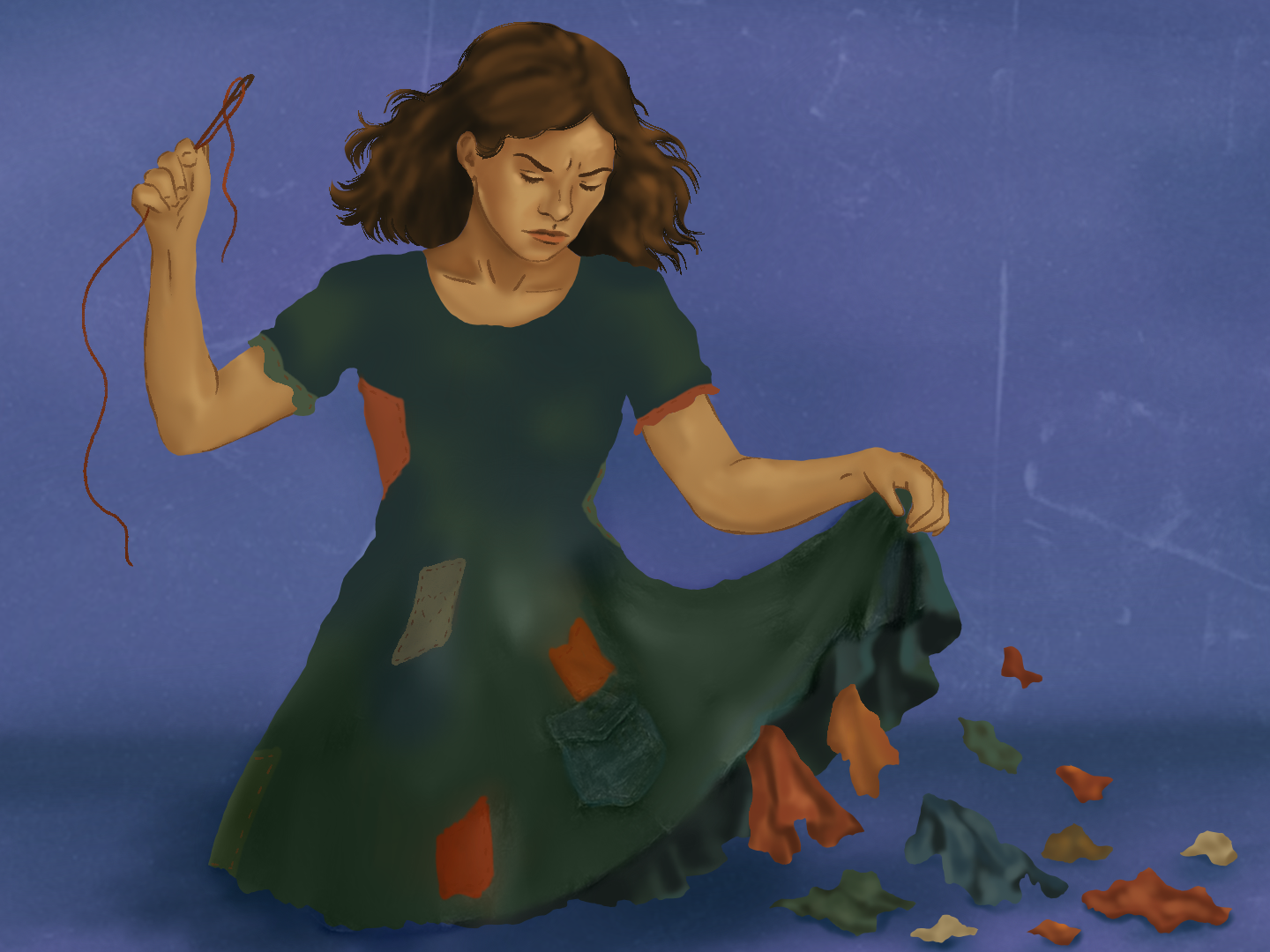
Illustration Daria Taranzhina
Textile production on Estonian territory dates back to the 19th century, and in the 20th century — as part of the Soviet Union — it was scaled up and became integrated into the broader Soviet industrial system. Major factories in Narva, Tallinn, and Tartu produced fabric and garments for the entire union. However, with the transition to a market economy, the collapse of former economic ties, privatization, and technological lag, the country's textile industry began to decline rapidly. By 2010, nearly all large factories had shut down, including the legendary Kreenholm. Mass production of textiles and clothing in Estonia had practically disappeared.
A similar trend was seen across Europe: from the late 20th century, mass textile and garment manufacturing began to shrink rapidly. Thousands of factories closed — especially in countries with expensive labor and high costs related to environmental and labor standards. Production moved to Asia, where labor is cheaper, regulations are minimal or absent, and logistics are tightly integrated into global supply chains. But alongside economic gain came growing negative consequences: pollution, labor exploitation, resource depletion, and a rising volume of textile waste — both during production and after use.
As the impacts of this fast, high-volume, low-cost model became more visible, a new direction began to take shape in many countries, including Estonia: sustainable design. Sustainable design rethinks the journey of clothing — from concept to wear — with attention to working conditions, product longevity, and reduced harm, while maintaining comfort, aesthetics, and accessibility. And although large-scale clothing production no longer takes place in Estonia, local designers, researchers, educators, and students continue to shape fashion — by developing sustainable practices, sharing knowledge, and offering alternative approaches.
One of Estonia’s most significant contributions to sustainable fashion is the UPMADE® system, developed by designer and researcher Reet Aus. In traditional production, around 18% of textile material ends up as waste — UPMADE® transforms this waste into a resource, enabling the creation of new, high-quality products. The system has been implemented in factories across several countries and is actively developing its digital tools — improving transparency in production chains and helping to manage industrial waste more effectively.
Reet Aus is not only a PhD-holding designer but also an activist drawing attention to systemic issues in the fashion industry. One of the key forms of her activism is the documentary film Out of Fashion, directed by Jaak Kilmi and Lennart Laberenz. The camera follows Reet from Tallinn to Europe’s runways, through cotton plantations in South America, and into mass-production factories in Bangladesh — revealing how the global fashion industry works and what impact it has on people and the environment. Out of Fashion is widely used in educational programs and public discussions — as a tool for understanding the problem and exploring solutions.
Sustainable thinking is becoming increasingly embedded in fashion and textile education in Estonia. Tallinn University of Technology offers a program in textile and garment production technology. Meanwhile, the Estonian Academy of Arts trains future fashion, textile, industrial, and environmental designers, with a strong focus on circular economy principles, conscious material selection, and product life cycles. In 2024, the academy launched a master's program in circular design. It also houses the DiMa Sustainable Design and Materials Lab, which leads international projects focused on upcycling, extending the life of clothing, and textile reuse — including ongoing research and applied development of the UPMADE® system.
Another educational and cultural hub advancing the topic of sustainable fashion is the Pallas University of Applied Sciences in Tartu. In collaboration with the Tartu Centre for Creative Industries and the University of Tartu’s Viljandi Culture Academy, they co-organize the Estonian Fashion Festival — a three-day event that brings together students and professional designers working with sustainable approaches.
The DisainiÖÖ Festival, held every autumn in Tallinn for over two decades, also plays a notable role in shaping Estonia’s design culture. Its themes span from eco-friendly materials and green innovation to AI, social space, and critiques of greenwashing. The festival is organized by the Estonian Association of Designers (EDL), which brings together over 180 professionals from the fields of fashion, graphic, textile, industrial, and furniture design. Its mission isn’t to promote more production but to rethink design as a bridge between culture, technology, and responsible business.
Narva is also an important voice in Estonia’s growing dialogue on sustainable fashion. The city hosts the Ida Mood festival — a grassroots initiative inspired by Narva’s textile heritage. The project team works with themes of sustainable fashion, creating a space where young designers and local residents meet. Ida Mood explores how fashion can be expressive and contemporary while remaining ethical and environmentally conscious. The festival program includes fashion shows featuring Estonian designers, lectures, and Swap party — an open clothing swap where garments are given a second life, and fashion becomes a medium for dialogue, experimentation, and rethinking consumption.
These examples are just part of a broader transformation happening within Estonia’s fashion sphere. While large-scale textile production has faded into history, it is increasingly seen as part of the country’s professional and cultural legacy. On that foundation, new ideas, initiatives, and educational models are emerging — shaping an alternative vision of fashion where creativity meets responsibility, and practicality doesn’t rule out expressiveness. Designers, students, researchers, and activists are leading this shift: developing sustainable approaches, sharing knowledge, and bringing them to life.
But sustainable fashion is not only about professional practice — it’s also about how we relate to our clothes in everyday life. Some people shop consciously, choosing only what they truly need. Others care for their garments, extend their lifespan, repair them, or pass them along. And some support those who build fashion on respect — for labor, for resources, for authorship — and avoid buying from brands built on exploitation and scale-at-any-cost production.
Sustainability in fashion is not a trend. It’s a way of paying attention — to ourselves, to others, to the planet.
A similar trend was seen across Europe: from the late 20th century, mass textile and garment manufacturing began to shrink rapidly. Thousands of factories closed — especially in countries with expensive labor and high costs related to environmental and labor standards. Production moved to Asia, where labor is cheaper, regulations are minimal or absent, and logistics are tightly integrated into global supply chains. But alongside economic gain came growing negative consequences: pollution, labor exploitation, resource depletion, and a rising volume of textile waste — both during production and after use.
As the impacts of this fast, high-volume, low-cost model became more visible, a new direction began to take shape in many countries, including Estonia: sustainable design. Sustainable design rethinks the journey of clothing — from concept to wear — with attention to working conditions, product longevity, and reduced harm, while maintaining comfort, aesthetics, and accessibility. And although large-scale clothing production no longer takes place in Estonia, local designers, researchers, educators, and students continue to shape fashion — by developing sustainable practices, sharing knowledge, and offering alternative approaches.
One of Estonia’s most significant contributions to sustainable fashion is the UPMADE® system, developed by designer and researcher Reet Aus. In traditional production, around 18% of textile material ends up as waste — UPMADE® transforms this waste into a resource, enabling the creation of new, high-quality products. The system has been implemented in factories across several countries and is actively developing its digital tools — improving transparency in production chains and helping to manage industrial waste more effectively.
Reet Aus is not only a PhD-holding designer but also an activist drawing attention to systemic issues in the fashion industry. One of the key forms of her activism is the documentary film Out of Fashion, directed by Jaak Kilmi and Lennart Laberenz. The camera follows Reet from Tallinn to Europe’s runways, through cotton plantations in South America, and into mass-production factories in Bangladesh — revealing how the global fashion industry works and what impact it has on people and the environment. Out of Fashion is widely used in educational programs and public discussions — as a tool for understanding the problem and exploring solutions.
Sustainable thinking is becoming increasingly embedded in fashion and textile education in Estonia. Tallinn University of Technology offers a program in textile and garment production technology. Meanwhile, the Estonian Academy of Arts trains future fashion, textile, industrial, and environmental designers, with a strong focus on circular economy principles, conscious material selection, and product life cycles. In 2024, the academy launched a master's program in circular design. It also houses the DiMa Sustainable Design and Materials Lab, which leads international projects focused on upcycling, extending the life of clothing, and textile reuse — including ongoing research and applied development of the UPMADE® system.
Another educational and cultural hub advancing the topic of sustainable fashion is the Pallas University of Applied Sciences in Tartu. In collaboration with the Tartu Centre for Creative Industries and the University of Tartu’s Viljandi Culture Academy, they co-organize the Estonian Fashion Festival — a three-day event that brings together students and professional designers working with sustainable approaches.
The DisainiÖÖ Festival, held every autumn in Tallinn for over two decades, also plays a notable role in shaping Estonia’s design culture. Its themes span from eco-friendly materials and green innovation to AI, social space, and critiques of greenwashing. The festival is organized by the Estonian Association of Designers (EDL), which brings together over 180 professionals from the fields of fashion, graphic, textile, industrial, and furniture design. Its mission isn’t to promote more production but to rethink design as a bridge between culture, technology, and responsible business.
Narva is also an important voice in Estonia’s growing dialogue on sustainable fashion. The city hosts the Ida Mood festival — a grassroots initiative inspired by Narva’s textile heritage. The project team works with themes of sustainable fashion, creating a space where young designers and local residents meet. Ida Mood explores how fashion can be expressive and contemporary while remaining ethical and environmentally conscious. The festival program includes fashion shows featuring Estonian designers, lectures, and Swap party — an open clothing swap where garments are given a second life, and fashion becomes a medium for dialogue, experimentation, and rethinking consumption.
These examples are just part of a broader transformation happening within Estonia’s fashion sphere. While large-scale textile production has faded into history, it is increasingly seen as part of the country’s professional and cultural legacy. On that foundation, new ideas, initiatives, and educational models are emerging — shaping an alternative vision of fashion where creativity meets responsibility, and practicality doesn’t rule out expressiveness. Designers, students, researchers, and activists are leading this shift: developing sustainable approaches, sharing knowledge, and bringing them to life.
But sustainable fashion is not only about professional practice — it’s also about how we relate to our clothes in everyday life. Some people shop consciously, choosing only what they truly need. Others care for their garments, extend their lifespan, repair them, or pass them along. And some support those who build fashion on respect — for labor, for resources, for authorship — and avoid buying from brands built on exploitation and scale-at-any-cost production.
Sustainability in fashion is not a trend. It’s a way of paying attention — to ourselves, to others, to the planet.
______________
This material is part of the PERSPECTIVES 2 project – a new label for independent, constructive, and multiperspective journalism. The project is funded by the European Union. The opinions and positions expressed are those of the author(s) and do not necessarily reflect the views or positions of the European Union or the European Education and Culture Executive Agency (EACEA). The European Union and EACEA assume no responsibility for them. Learn more about PERSPECTIVES.
This material is part of the PERSPECTIVES 2 project – a new label for independent, constructive, and multiperspective journalism. The project is funded by the European Union. The opinions and positions expressed are those of the author(s) and do not necessarily reflect the views or positions of the European Union or the European Education and Culture Executive Agency (EACEA). The European Union and EACEA assume no responsibility for them. Learn more about PERSPECTIVES.
