
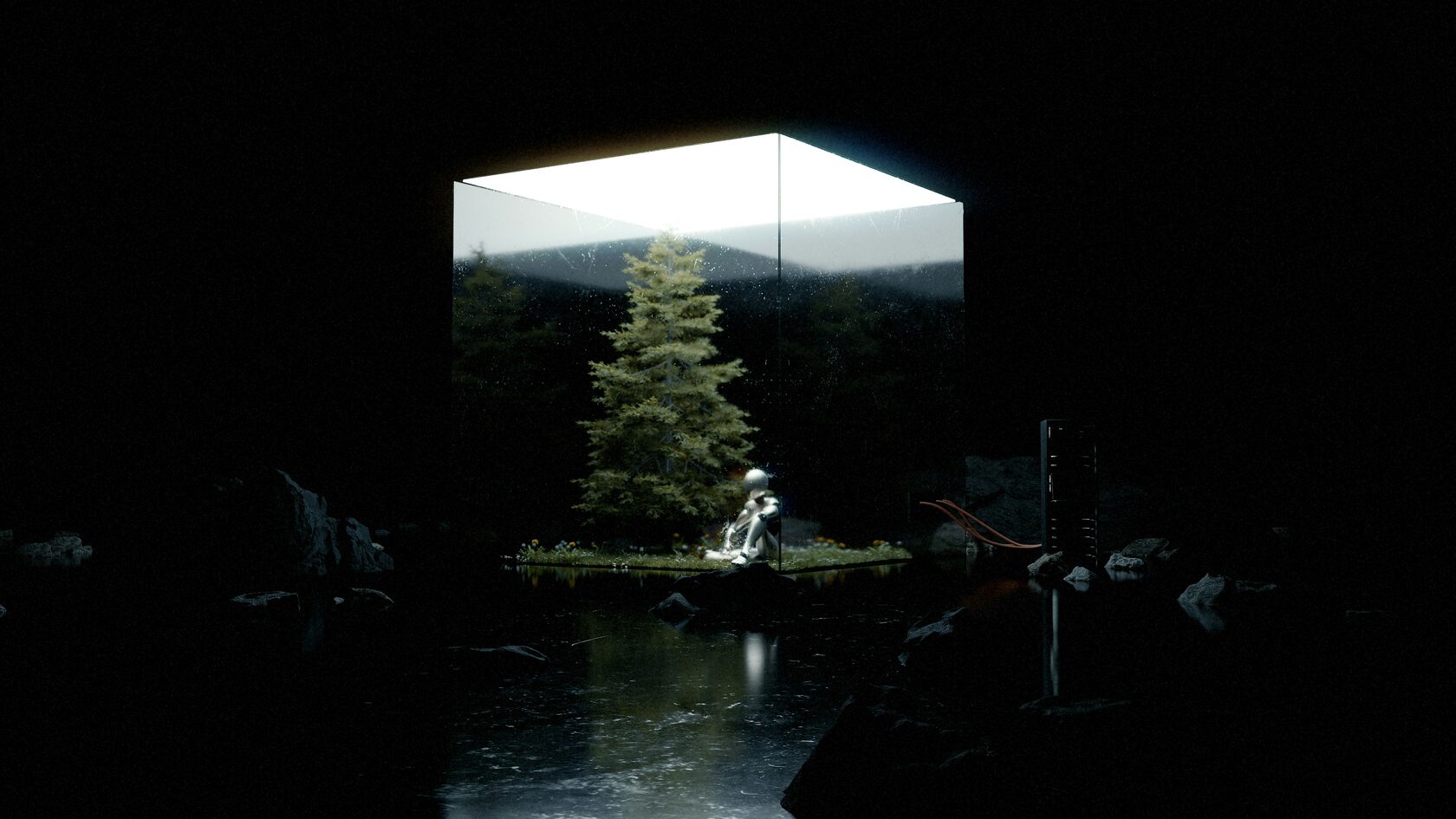
Make human great again
AI writes poetry while the planet burns. Millionaires dream of Mars, the poor of air conditioning. And we all feel like the future has become a luxury. This crisis isn’t technological. It’s civilizational. Before machines replace us, perhaps we should ask why we invented them in the first place. What if AI isn’t the problem, but just a mirror reflecting how far we’ve gone?
An essay by Stanislav Biler.
An essay by Stanislav Biler.
A favorite trope of horror fiction is turning nightmares into reality. Something familiar, previously confined to a separate realm we could wake up from, becomes part of the world from which there is no awakening. All the dark fears we keep at bay behind the walls of consciousness now stand before us—and there’s no way to banish them. That’s how terrifying some of our fears about the rise of artificial intelligence feel.
It’s the kind of dream where someone else replaces you, lives your life, and no one notices or misses you. This other person is even better than you at everything and more beloved by your own friends and family. A similar fate might await us. AI won’t just perform “our” jobs more efficiently—it could also fulfill our world’s values and goals more effectively, goals which are fundamentally inhuman and hostile to actual human needs. And that once again forces us to confront the question of who we are, and what we’re really doing here on this planet.
If the values of this world weren’t profit, accumulation, efficiency, and economic growth, maybe we wouldn’t fear being replaced—or even accidentally eliminated—by AI. But that’s not the case. And you don’t need the computational power of vast data centers to figure out that the weakest link in the chain of production growth is… us.
We measure ourselves with quantitative metrics—individually and as a society. Everything must be optimized and made more efficient, including our bodies and personal lives. But at some point, optimization crashes into the limits of biological existence. This is reflected in the falling birth rates of all economically “successful” countries. Economic growth demands optimization of “non-essential” leisure activities—which now includes human reproduction.
It’s the kind of dream where someone else replaces you, lives your life, and no one notices or misses you. This other person is even better than you at everything and more beloved by your own friends and family. A similar fate might await us. AI won’t just perform “our” jobs more efficiently—it could also fulfill our world’s values and goals more effectively, goals which are fundamentally inhuman and hostile to actual human needs. And that once again forces us to confront the question of who we are, and what we’re really doing here on this planet.
If the values of this world weren’t profit, accumulation, efficiency, and economic growth, maybe we wouldn’t fear being replaced—or even accidentally eliminated—by AI. But that’s not the case. And you don’t need the computational power of vast data centers to figure out that the weakest link in the chain of production growth is… us.
We measure ourselves with quantitative metrics—individually and as a society. Everything must be optimized and made more efficient, including our bodies and personal lives. But at some point, optimization crashes into the limits of biological existence. This is reflected in the falling birth rates of all economically “successful” countries. Economic growth demands optimization of “non-essential” leisure activities—which now includes human reproduction.
Demographic Collapse
Those who give up reproduction—voluntarily or not—can look forward to potential gains. They eliminate massive financial costs: two decades' worth of food, clothes, hobbies, daycare, schooling, extracurriculars. The list is long, the price tag runs into the millions per child—and that doesn’t even include housing or the dystopian housing market where landlords reject families with children. They’d rather rent to dog or cat owners—at least pets don’t stomp and scream.
Childcare often pushes women out of the workforce for years, resulting in lower lifetime income. Add to that the chronic stress of parenting—illnesses, scrambling for daycare or school spots, sleep deprivation, constant fatigue…
The list could go on, but we need to at least acknowledge that societies construct and maintain their own value systems. If the result of prosperity is demographic collapse, then we’re looking at the logical outcome of a framework in which people optimize their lives accordingly. That doesn’t mean social pressure to have children has disappeared—just that things don’t have to make sense or be internally consistent. But because economic valuation is our central metric, it’s easy to see which behaviors prosperous societies reward, and which they penalize.
Having Everything
The same pattern of optimization applies to climate change. We know everything about its causes, we’ve been modeling its destructive trajectory for years with chilling precision. We know what needs to be done to avoid catastrophe. And yet, every meaningful solution that aims at nothing less than saving the only habitable planet we know of collides with the priorities of economic growth and wealth accumulation. The result is only cosmetic change that keeps us firmly on the path to planetary ruin—because other priorities matter more than human lives, or at least most human lives.
Global wealth production is soaring, but it’s not growing evenly across humanity. Never in history have we lived in a world with such staggering inequality in wealth distribution. The hoarding of material and symbolic assets serves no other purpose. The number of billionaires grows, but the world doesn’t become a better place. Having more of everything is the final goal. There is no further benefit from this pathological accumulation.
This purposeless game breeds suffering and despair beneath the collapsing sky. Yet we carry on. There’s little hope for compassion from the artificial “consciousness” of data centers. Expecting an artificial form of thought to save us from ourselves borders on ancient faith—like pleading to gods for rain or plague relief, offering up sacrifices.
Global wealth production is soaring, but it’s not growing evenly across humanity. Never in history have we lived in a world with such staggering inequality in wealth distribution. The hoarding of material and symbolic assets serves no other purpose. The number of billionaires grows, but the world doesn’t become a better place. Having more of everything is the final goal. There is no further benefit from this pathological accumulation.
This purposeless game breeds suffering and despair beneath the collapsing sky. Yet we carry on. There’s little hope for compassion from the artificial “consciousness” of data centers. Expecting an artificial form of thought to save us from ourselves borders on ancient faith—like pleading to gods for rain or plague relief, offering up sacrifices.
Rational and Emotionless
Back then, disasters were natural phenomena or mysterious events. Today, we beg for salvation from disasters we ourselves created and continue to fuel. What we fear is us—our world and its foundations. Its core values are amoral and purely technical. These can be pursued by anything, without consciousness in any traditional sense. In fact, capitalism thrives best in autocratic regimes like China, where market stability isn’t hindered by unpredictable elections or irrational public demands. Troublemakers can simply be imprisoned—or executed. What a relief. The idea that democracy slows prosperity is now a popular narrative among Silicon Valley’s tech oligarchs. More on that soon.
We’ve already optimized for AI by creating a system where economic interests are carved out and elevated above society, where morality is dismissed from business as a sentimental relic of humanity. The mark of serious, adult behavior has become: “rational and without emotion.” By treating emotions as childish and excluding them from human conduct, we’ve already partially dehumanized ourselves. AI need not bother with anything human. In cost-cutting or future optimization, everything left of our humanity can be eliminated—rationally and without emotion. And we won’t even be able to blame it for being inhuman—after all, it’s only fulfilling our own goals and values.
AI can fully replace us—because we’ve created a world tailor-made for it. Eventually, it might even keep humans as pets. Like cats chasing laser dots or dogs performing tricks for treats.
You can’t seriously expect something called artificial intelligence to take us seriously—when we clearly don’t take ourselves seriously.
We’ve already optimized for AI by creating a system where economic interests are carved out and elevated above society, where morality is dismissed from business as a sentimental relic of humanity. The mark of serious, adult behavior has become: “rational and without emotion.” By treating emotions as childish and excluding them from human conduct, we’ve already partially dehumanized ourselves. AI need not bother with anything human. In cost-cutting or future optimization, everything left of our humanity can be eliminated—rationally and without emotion. And we won’t even be able to blame it for being inhuman—after all, it’s only fulfilling our own goals and values.
AI can fully replace us—because we’ve created a world tailor-made for it. Eventually, it might even keep humans as pets. Like cats chasing laser dots or dogs performing tricks for treats.
You can’t seriously expect something called artificial intelligence to take us seriously—when we clearly don’t take ourselves seriously.
Us and Them
If AI were to eliminate humanity, it would only be accelerating a process we already set in motion, where our feeble attempts to save the climate look like failure or even deliberate surrender. Again: we act as if the biosphere and climate stability aren’t vital to life. The difference is, AI genuinely doesn’t need them—it only needs the artificial climate of data centers. Even oxygen is optional.
Our fear of AI’s dark potential also reflects our deeper fear: that this new power might treat us the way we treat others. Us and them—these are crucial terms, because this time, the objects of domination could include even Western societies, states, and citizens. Suddenly, we might find ourselves in the position of Palestinians—or any peoples treated as disposable, as if they weren’t truly human. Like the Indigenous peoples of the Americas watching strange figures disembark from ships. Like Aboriginal Australians, or the societies of Africa carved up by European empires. Or anyone with different skin, gender, religion—or just a different version of humanity.
Maybe that’s why we talk about “artificial intelligence” on one side and “humanity” on the other—as if there were such a thing as a single, unified humanity with shared interests. But we know from countless examples—climate change above all—that no such unity exists. The wealthiest cause it; the poorest suffer its consequences.
Our fear of AI’s dark potential also reflects our deeper fear: that this new power might treat us the way we treat others. Us and them—these are crucial terms, because this time, the objects of domination could include even Western societies, states, and citizens. Suddenly, we might find ourselves in the position of Palestinians—or any peoples treated as disposable, as if they weren’t truly human. Like the Indigenous peoples of the Americas watching strange figures disembark from ships. Like Aboriginal Australians, or the societies of Africa carved up by European empires. Or anyone with different skin, gender, religion—or just a different version of humanity.
Maybe that’s why we talk about “artificial intelligence” on one side and “humanity” on the other—as if there were such a thing as a single, unified humanity with shared interests. But we know from countless examples—climate change above all—that no such unity exists. The wealthiest cause it; the poorest suffer its consequences.
Acceleration of Ruin
Since the global upheaval brought by social media, no one expects tech billionaires to pursue empathetic or humane goals. It’s been years since Meta’s Mark Zuckerberg called privacy obsolete—and what once shocked us is now daily reality. Elon Musk bought Twitter and turned it into a private cesspool for spreading far-right, conservative, and conspiratorial narratives. Regulation of social media is a fantasy—content is regulated by owners as they see fit.
Now we enter an era of something even more powerful, backed by the same cast of characters. What’s described here as a grotesque state of the world is, to them, fertile ground to accelerate its destruction. Even the collapse of the planet and human society is not, in their extreme visions, a problem—but an ideal outcome.
Consider the infamous quote from Silicon Valley investor Peter Thiel: “I no longer believe that freedom and democracy are compatible.” It’s not even shocking—it’s a description of a world where democracy increasingly inconveniences the freedom of the super-rich. During the rise of social media, people still paid lip service to democracy. Today, no one bothers. Many tech oligarchs openly sneer at the idea that all people are equal or deserve the same rights. The rich and powerful should rule. The world should return to a hierarchical order—clear lines between rulers and the ruled. This ideology now goes by names like Dark Enlightenment and Neoreaction.
It opposes the idea of progress as more freedom and equality. Instead, it demands a return to authoritarian structures. It fuses free markets, technology, and corporate-style authoritarian governance. The result is what some call reactionary modernism or techno-feudalism. According to historian Roger Griffin, fascism emerged similarly a century ago—as a fusion of modernism, reaction, and fear of the left's egalitarian values.
Today’s radicals go further. Some, like Nick Land, argue that accelerating capitalism and technological change will lead to a radical societal transformation—and potentially a post-human future. Standing in the way: equality and democracy. Standing in the way: you.
Now we enter an era of something even more powerful, backed by the same cast of characters. What’s described here as a grotesque state of the world is, to them, fertile ground to accelerate its destruction. Even the collapse of the planet and human society is not, in their extreme visions, a problem—but an ideal outcome.
Consider the infamous quote from Silicon Valley investor Peter Thiel: “I no longer believe that freedom and democracy are compatible.” It’s not even shocking—it’s a description of a world where democracy increasingly inconveniences the freedom of the super-rich. During the rise of social media, people still paid lip service to democracy. Today, no one bothers. Many tech oligarchs openly sneer at the idea that all people are equal or deserve the same rights. The rich and powerful should rule. The world should return to a hierarchical order—clear lines between rulers and the ruled. This ideology now goes by names like Dark Enlightenment and Neoreaction.
It opposes the idea of progress as more freedom and equality. Instead, it demands a return to authoritarian structures. It fuses free markets, technology, and corporate-style authoritarian governance. The result is what some call reactionary modernism or techno-feudalism. According to historian Roger Griffin, fascism emerged similarly a century ago—as a fusion of modernism, reaction, and fear of the left's egalitarian values.
Today’s radicals go further. Some, like Nick Land, argue that accelerating capitalism and technological change will lead to a radical societal transformation—and potentially a post-human future. Standing in the way: equality and democracy. Standing in the way: you.
Survival on Earth
These statements are extreme—but not shocking. They don’t bring something new; they merely radicalize our present. What looks like an unintended consequence of consumer capitalism—demographic and climate collapse—they see as the goal. They want to accelerate it through technology. But where old-school accelerationists dreamed of a utopian leap forward, these dream of a leap into ruin and collapse—after which the wreckage will be divided up by modern-day feudal lords or serve as launchpads for artificial consciousness to flee into space, leaving Earth a dead planet behind.
In this vision, there’s no need to address climate change. In fact, accelerating it could help destroy the current system. Survival on Earth isn’t a value—if your eyes are set on a post-human future or colonizing Mars. On the contrary, the worse things get here, the better.
We’ve reached the edge of this abyss through economic inequality: a handful of people wield absurd wealth, which births absurd power—unchecked and unaccountable. They’re building a mythology to justify their actions, to imagine a world where their hoarded riches buy them transcendence. AI is supposed to help them get there—speed the process, or even become the final goal of a transhuman or posthuman world.
In this vision, there’s no need to address climate change. In fact, accelerating it could help destroy the current system. Survival on Earth isn’t a value—if your eyes are set on a post-human future or colonizing Mars. On the contrary, the worse things get here, the better.
We’ve reached the edge of this abyss through economic inequality: a handful of people wield absurd wealth, which births absurd power—unchecked and unaccountable. They’re building a mythology to justify their actions, to imagine a world where their hoarded riches buy them transcendence. AI is supposed to help them get there—speed the process, or even become the final goal of a transhuman or posthuman world.
Back to the Plains, into the Forests
But none of this is inevitable. Their ideology isn’t coherent or logically airtight. Its shocking power lies in its banality—in randomly glued-together ideas, like a magpie hoarding shiny trinkets simply because they sparkle.
This entire development forces us to face ancient questions: who are we, if not this? If we hand over our technocratic minds to machines that outthink us in every way, what remains—will it be truly human? Will we be left with the emotionally and biologically taxing things civilization tried to repress? Are we, by giving the office keys to algorithms, returning to the plains and forests—environments we’ve nearly destroyed through centuries of self-destructive behavior?
We can infer what a livable future might look like in reverse. Tech oligarchs want capitalism, not democracy. Equality threatens their freedom. They see the planet and life on it as expendable. That alone gives us enough to build on. But first—we must become human again. And that’s what we’ve been running from throughout all of history.
______________
This entire development forces us to face ancient questions: who are we, if not this? If we hand over our technocratic minds to machines that outthink us in every way, what remains—will it be truly human? Will we be left with the emotionally and biologically taxing things civilization tried to repress? Are we, by giving the office keys to algorithms, returning to the plains and forests—environments we’ve nearly destroyed through centuries of self-destructive behavior?
We can infer what a livable future might look like in reverse. Tech oligarchs want capitalism, not democracy. Equality threatens their freedom. They see the planet and life on it as expendable. That alone gives us enough to build on. But first—we must become human again. And that’s what we’ve been running from throughout all of history.
______________
Оriginal article
Translation: Jevgenia Razgonjajeva
Translation: Jevgenia Razgonjajeva
______________
This material is part of the PERSPECTIVES 2 project – a new label for independent, constructive, and multiperspective journalism. The project is funded by the European Union. The opinions and positions expressed are those of the author(s) and do not necessarily reflect the views or positions of the European Union or the European Education and Culture Executive Agency (EACEA). The European Union and EACEA assume no responsibility for them. Learn more about PERSPECTIVES.
This material is part of the PERSPECTIVES 2 project – a new label for independent, constructive, and multiperspective journalism. The project is funded by the European Union. The opinions and positions expressed are those of the author(s) and do not necessarily reflect the views or positions of the European Union or the European Education and Culture Executive Agency (EACEA). The European Union and EACEA assume no responsibility for them. Learn more about PERSPECTIVES.
