
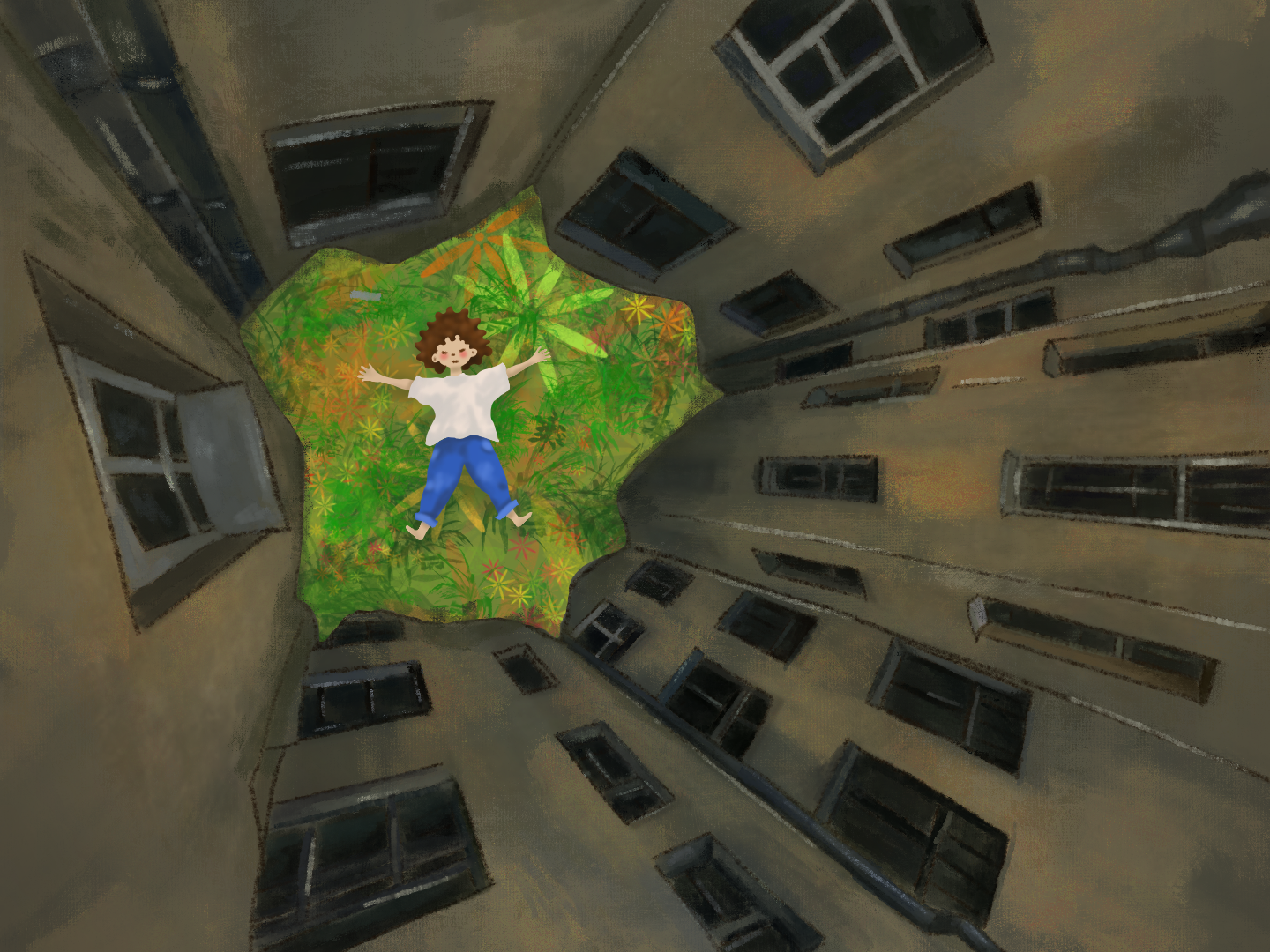
Illustration Daria Taranzhina
In Lithuania and Estonia, the process of transformation begins in the heart of the cities. From the Vilnius Urban Lab to the Kreenholm Garden in Narva, communities are reshaping urban spaces and restoring their connection with nature and each other.
Miesto Laboratorija
When we think of “green,” “sustainable,” or “regenerative,” we often imagine an off-grid house hidden deep within untouched forests – or do we? For many, heavily urbanised areas are not typically associated with sustainable living, especially large cities, which are often overwhelmed by traffic and air pollution. Historically, Soviet oppression had a negative impact on urban environments, characterised by heavy urbanisation and overdevelopment, which psychologically distanced city dwellers from both nature and themselves. Today, Lithuanian neighborhoods and residents are experiencing an eco-renaissance – redefining their relationship with nature and community, and reshaping the mindset of post-Soviet urban life.
Lithuania’s capital, Vilnius, has much to offer – from its UNESCO-protected Old Town to its vibrant art scene and startup-friendly energy. But if you cycle along the Neris River, you might stumble upon a hidden gem near the historic Sapiegos Palace. Miesto Laboratorija (translated as “City Lab”) is a community-run hub where people come together to learn how to live more sustainably – both outwardly and inwardly.
It all began with the Antakalnis Urban Garden. Through gardening, neighbors got to know one another and discovered shared values: community engagement, love and respect for nature, and an environmentally conscious lifestyle. This blossomed into a series of events and initiatives, including food-sharing programs, educational workshops, Christmas fairs, and more, where like-minded people could meet.
Regular gardeners Goda ir Agnė realized they needed a permanent space – not just a garden – to bring their ideas to life. They dreamed of creating a community-built educational café and center. That’s how Miesto Laboratorija was born.
The dream became a reality thanks to local support – volunteers lent a hand, and others donated furniture and decor. When you visit the center, you're surrounded by a second-hand interior that reflects the neighborhood's rich history. Bit by bit, funds were raised through bake sales and other donations. The community even won a municipal contest to host the center in a former hospital building. Now, Miesto Laboratorija operates as an example of what can be achieved when community values drive action.
“We base every decision on two questions: is it sustainable, and does it benefit the community?” says Goda, which is evident. The center is powered by solar collectors, features an outdoor compost for organic waste, and uses a greywater system that repurposes sink water to flush toilets. Nearly every detail reflects a creative reuse – tables made from hospital doors, ceiling lamps from old gas tanks, and cabinet door knobs from spoons. Even all dishes and kitchen equipment are second-hand – everything has found a new purpose.
The café tackles food waste through cooking workshops that teach portioning, resource-saving, and creative reuse. One pilot project successfully reduced food waste by 49.92%, saving 924 kg of food. This, in turn, prevented 6.6 tons of CO₂ emissions and preserved 1,698 food portions in 2023.
And that’s not all! The center also features a hydroponic vertical garden, a local art gallery, and an open-plan, DIY-style playground for kids. Miesto Laboratorija is a space for sustainability education – offering workshops on gardening, food waste prevention, and mindful living. The center is always open to new initiatives. Latest additions are Dėkui Kabykla – a hanging rack to swap second-hand clothing and community fridge that’s emptied within minutes. Repair Cafés are the trendy new events where people bring beloved items to be fixed by skilled local menders.
Founded to bring the Antakalnis community together, Miesto Laboratorija has sparked real change over the past decade – growing a more active, engaged, and proud neighborhood. “People often say they’re proud to live in Antakalnis because of Miesto Laboratorija!” reflects Goda.
Lithuania’s capital, Vilnius, has much to offer – from its UNESCO-protected Old Town to its vibrant art scene and startup-friendly energy. But if you cycle along the Neris River, you might stumble upon a hidden gem near the historic Sapiegos Palace. Miesto Laboratorija (translated as “City Lab”) is a community-run hub where people come together to learn how to live more sustainably – both outwardly and inwardly.
It all began with the Antakalnis Urban Garden. Through gardening, neighbors got to know one another and discovered shared values: community engagement, love and respect for nature, and an environmentally conscious lifestyle. This blossomed into a series of events and initiatives, including food-sharing programs, educational workshops, Christmas fairs, and more, where like-minded people could meet.
Regular gardeners Goda ir Agnė realized they needed a permanent space – not just a garden – to bring their ideas to life. They dreamed of creating a community-built educational café and center. That’s how Miesto Laboratorija was born.
The dream became a reality thanks to local support – volunteers lent a hand, and others donated furniture and decor. When you visit the center, you're surrounded by a second-hand interior that reflects the neighborhood's rich history. Bit by bit, funds were raised through bake sales and other donations. The community even won a municipal contest to host the center in a former hospital building. Now, Miesto Laboratorija operates as an example of what can be achieved when community values drive action.
“We base every decision on two questions: is it sustainable, and does it benefit the community?” says Goda, which is evident. The center is powered by solar collectors, features an outdoor compost for organic waste, and uses a greywater system that repurposes sink water to flush toilets. Nearly every detail reflects a creative reuse – tables made from hospital doors, ceiling lamps from old gas tanks, and cabinet door knobs from spoons. Even all dishes and kitchen equipment are second-hand – everything has found a new purpose.
The café tackles food waste through cooking workshops that teach portioning, resource-saving, and creative reuse. One pilot project successfully reduced food waste by 49.92%, saving 924 kg of food. This, in turn, prevented 6.6 tons of CO₂ emissions and preserved 1,698 food portions in 2023.
And that’s not all! The center also features a hydroponic vertical garden, a local art gallery, and an open-plan, DIY-style playground for kids. Miesto Laboratorija is a space for sustainability education – offering workshops on gardening, food waste prevention, and mindful living. The center is always open to new initiatives. Latest additions are Dėkui Kabykla – a hanging rack to swap second-hand clothing and community fridge that’s emptied within minutes. Repair Cafés are the trendy new events where people bring beloved items to be fixed by skilled local menders.
Founded to bring the Antakalnis community together, Miesto Laboratorija has sparked real change over the past decade – growing a more active, engaged, and proud neighborhood. “People often say they’re proud to live in Antakalnis because of Miesto Laboratorija!” reflects Goda.
Šilainių sodai
Did you know that Lithuania has a second capital? Kaunas, the country’s second-largest city, served as a temporary capital during the interwar period. During this time, Art Deco art and architecture flourished, earning Kaunas the nickname “the Lithuanian capital of modernism”. But Kaunas is more than just beautiful modernist houses tucked between linden trees.
Like many post-Soviet cities, it features a vast suburban neighborhood of high-rise buildings called Šilainiai. However, it’s not your typical soviet block. Hidden within the crevices of the 19th-century Kaunas Fortress lies another kind of stronghold: a community of pensioners cultivating urban gardens.
Around 40 years ago, locals began cultivating fruits and vegetables on the fortress grounds, driven by a growing need for self-sufficiency. They dug garden beds and built greenhouses. Despite legal challenges and frequent opposition from locals, the gardening community persisted and steadily expanded. “The long-standing tradition of urban gardening in Lithuanian cities is now sustained only by informal communities – often in secluded areas and with a sense of apprehension,” says Evelina, a gardener and an artist.
Evelina, alongside urbanist Rūta, immediately recognised the potential to explore the social movement of urban gardens as an art form. They understood that gardening and horticulture could be more than just growing vegetables – it could be a form of collective performance, where every action, from planting seeds to harvesting crops, serves as an expression of community spirit.
The goal was to create a safe space to escape the city noise and rebuild the connection with nature through gardening. For such a project to take root, it was first necessary to ensure both physical and psychological safety for the gardeners. Through regular community work sessions, volunteers got their hands dirty to deliver a more physical skeleton to Šilainiai Gardens: a new information board, gardening beds were constructed, rain collection, organic waste composts were provided to ease gardening and new seating area invites visitors to slow down and spend time in the space.
“By sharing what everyday life is like in the gardens, we hope more people will hear about it and start seeing urban gardening as something really positive,” – Evelina says. Residents were invited to participate in an educational program to develop gardening skills. Shortly, Rūta and Evelina noticed that young people seemed detached from natural systems and unaware of where food comes from.
The impact of the hands-on experience exploring food systems through gardening inspired the organisers to expand this methodology further. They developed a 10-month study program to address climate change through food systems under NGO Kultūros dirbtuvė (Culture Atelier). The core themes – food, ecosystem, biodiversity, and climate change – are explored within the local context. The program’s calendar aligns with both seasonal nature cycles and academic schedule. A group of sustainability, regeneration, and biology specialists hold regular sessions at least once per month to explore and promote healthy eating, environmental consciousness, and community building.
Similar experiential learning programs, such as nature walks in the city held by 9 zuikiai (9 rabbits) are sprouting too. The need to reconnect with nature is more prominent than ever. The message is clear: if people do not feel part of nature, they’re less likely to protect it. With a little motivation (okay, a lot) and some elbow grease, you can help people rediscover nature – even in the backyard of a Soviet block home or an old hospital.
Like many post-Soviet cities, it features a vast suburban neighborhood of high-rise buildings called Šilainiai. However, it’s not your typical soviet block. Hidden within the crevices of the 19th-century Kaunas Fortress lies another kind of stronghold: a community of pensioners cultivating urban gardens.
Around 40 years ago, locals began cultivating fruits and vegetables on the fortress grounds, driven by a growing need for self-sufficiency. They dug garden beds and built greenhouses. Despite legal challenges and frequent opposition from locals, the gardening community persisted and steadily expanded. “The long-standing tradition of urban gardening in Lithuanian cities is now sustained only by informal communities – often in secluded areas and with a sense of apprehension,” says Evelina, a gardener and an artist.
Evelina, alongside urbanist Rūta, immediately recognised the potential to explore the social movement of urban gardens as an art form. They understood that gardening and horticulture could be more than just growing vegetables – it could be a form of collective performance, where every action, from planting seeds to harvesting crops, serves as an expression of community spirit.
The goal was to create a safe space to escape the city noise and rebuild the connection with nature through gardening. For such a project to take root, it was first necessary to ensure both physical and psychological safety for the gardeners. Through regular community work sessions, volunteers got their hands dirty to deliver a more physical skeleton to Šilainiai Gardens: a new information board, gardening beds were constructed, rain collection, organic waste composts were provided to ease gardening and new seating area invites visitors to slow down and spend time in the space.
“By sharing what everyday life is like in the gardens, we hope more people will hear about it and start seeing urban gardening as something really positive,” – Evelina says. Residents were invited to participate in an educational program to develop gardening skills. Shortly, Rūta and Evelina noticed that young people seemed detached from natural systems and unaware of where food comes from.
The impact of the hands-on experience exploring food systems through gardening inspired the organisers to expand this methodology further. They developed a 10-month study program to address climate change through food systems under NGO Kultūros dirbtuvė (Culture Atelier). The core themes – food, ecosystem, biodiversity, and climate change – are explored within the local context. The program’s calendar aligns with both seasonal nature cycles and academic schedule. A group of sustainability, regeneration, and biology specialists hold regular sessions at least once per month to explore and promote healthy eating, environmental consciousness, and community building.
Similar experiential learning programs, such as nature walks in the city held by 9 zuikiai (9 rabbits) are sprouting too. The need to reconnect with nature is more prominent than ever. The message is clear: if people do not feel part of nature, they’re less likely to protect it. With a little motivation (okay, a lot) and some elbow grease, you can help people rediscover nature – even in the backyard of a Soviet block home or an old hospital.
Estonia is also moving forward — our cities are becoming greener and smarter. Sustainability is in fashion, and more and more people are embracing this change. Urban spaces are evolving too, with a focus on comfort and environmental awareness.
Here are a few great examples that prove it:
Here are a few great examples that prove it:
Kastani aed, Tartu
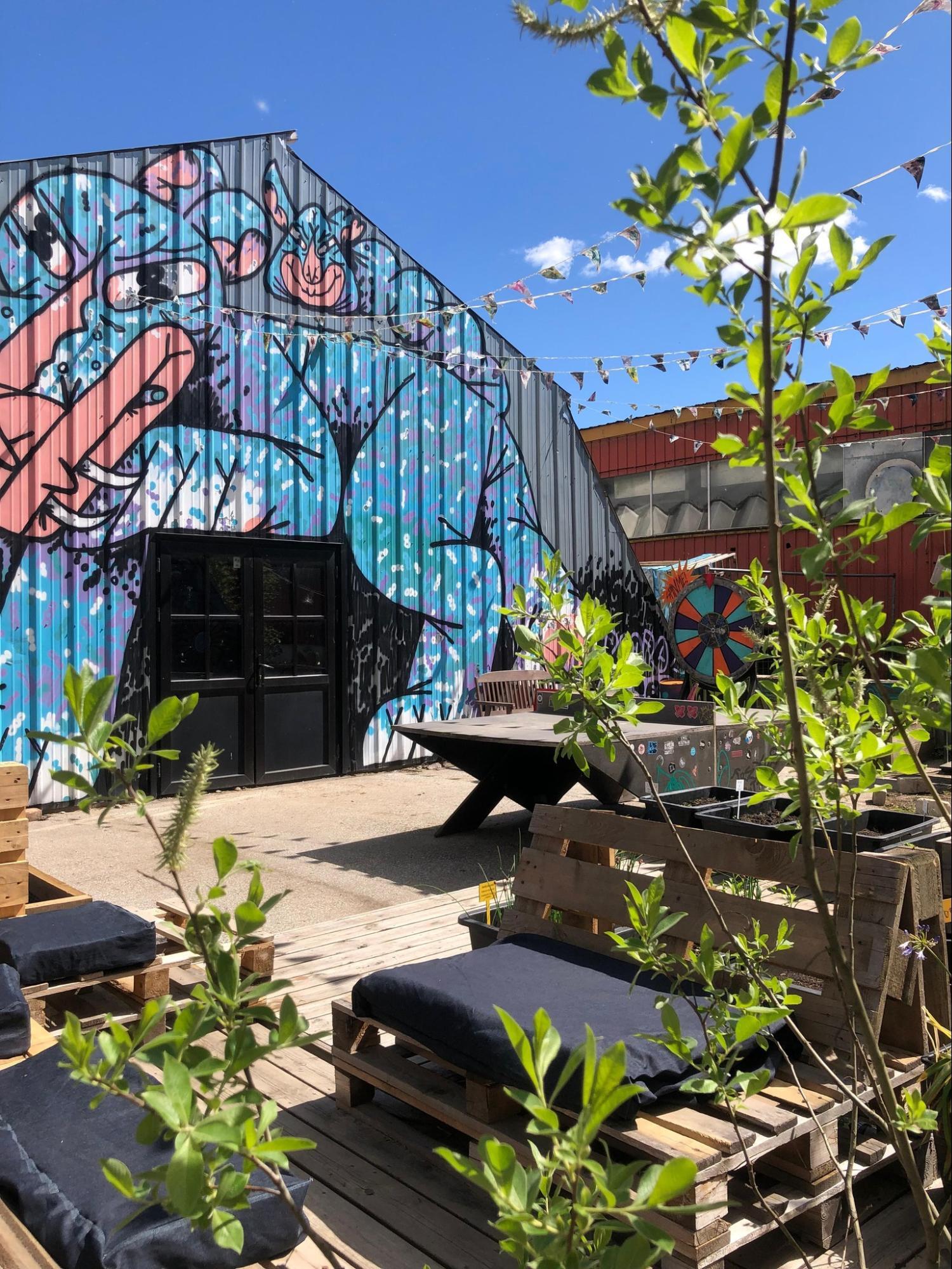
The project was relaunched in April 2025 with the goal of developing an eco-friendly urban community. Most of the activities take place at Ajuokse Avangaar in Tartu, where participants come together to clean the area, plant new plants, create new installations from recycled materials — and, of course, connect with each other! Much of the garden’s infrastructure is built with sustainability and reuse in mind: decorations are made from TYPA’s old printing rags, furniture from Plantarium’s pallets, and cushions from fabric scraps and old mattresses.
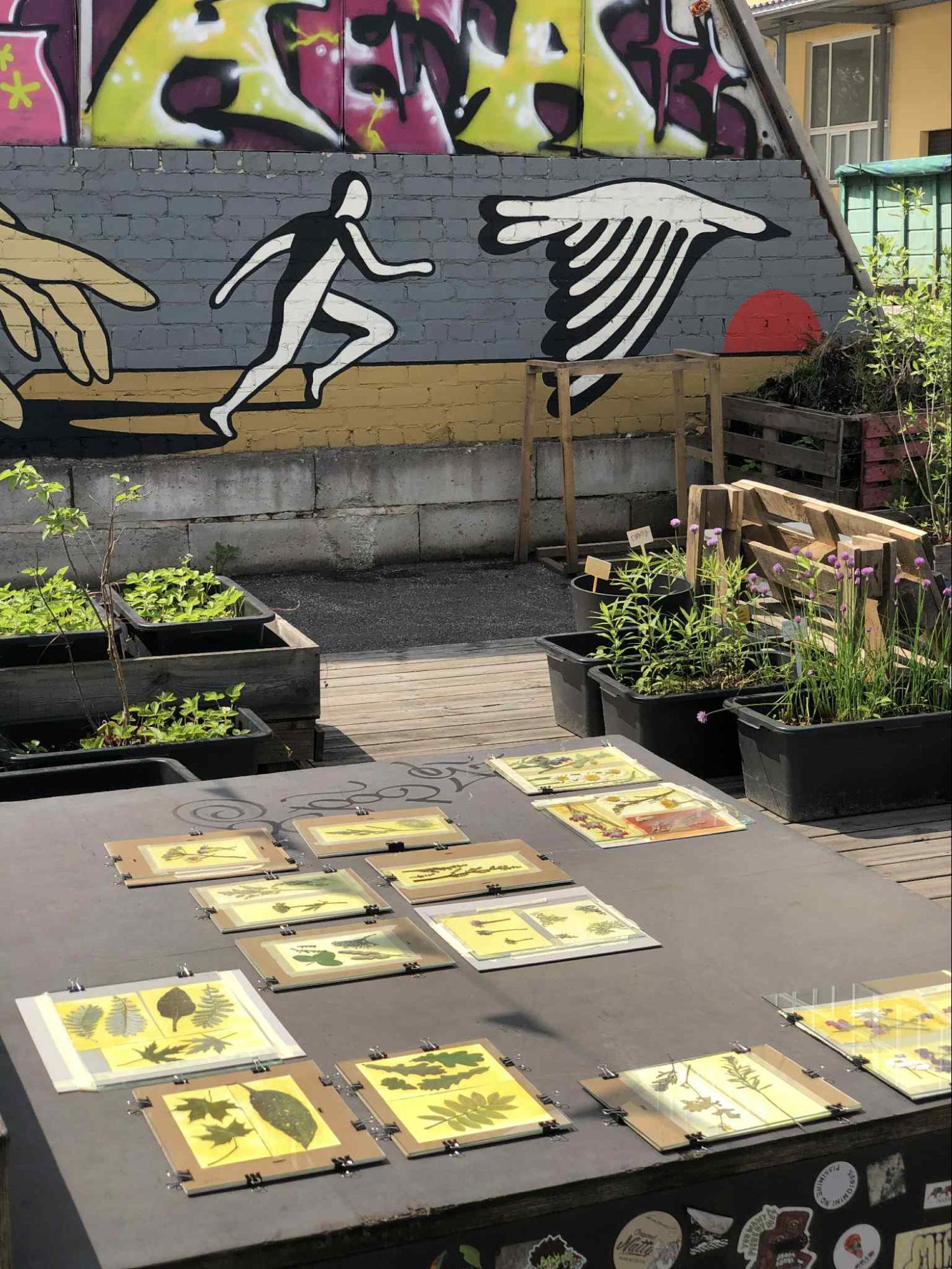
Tadeusz, a volunteer with the European Solidarity Corps at Aparaaditehas and part-time organizer of Kastani aed, explains:
"The space behind TYPA used to be a community garden, but over time it fell into disrepair—people simply didn't have the time or energy to maintain it. I discussed this problem with TYPA staff, talked to the owner of Plantarium, and together we decided to revive this space, to carry out a kind of intervention to make it cozy and open to all local residents. We decided to focus on the community and a sustainable approach. Now we have about 15 participants from different backgrounds who tend to their beds and flower beds: some plant flowers, others plant vegetables and herbs."
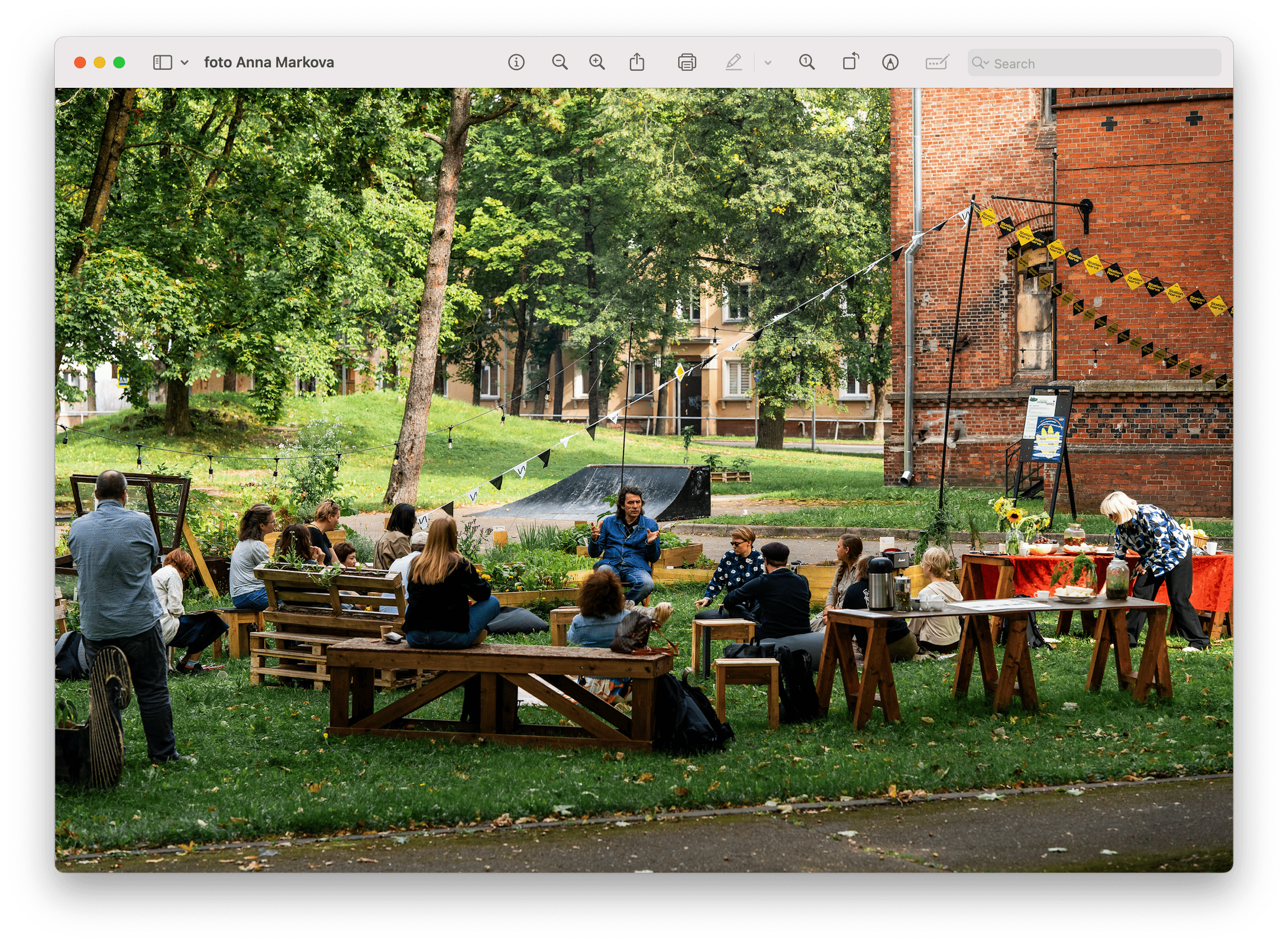
The first green space in Narva where local residents can freely garden, take part in workshops, and simply enjoy time together outdoors. The garden was created in 2020 by artists Sandra Kosorotova and Sille Kima next to the Narva Art Residency. Since its inception, the garden and its concept have undergone several transformations. In 2023, the space was significantly expanded, with Maria Kopytova becoming the project’s curator.
“The main goal of the garden is to strengthen and develop the Kreenholm community. Not only invited artists but also local residents take an active part in its life. We collaborate with community organizations, host international artists, and take part in public city events. At the same time, our core focus remains on environmental awareness, urban gardening, and openness to the community. In 2025, the project is supported by the Just Transition Fund — we’re planning a collective construction of a green pavilion with a terrace, a summer school on building, and a series of public lectures”, says Maria.
Kogukonnaaiad, Tallinn, Tartu
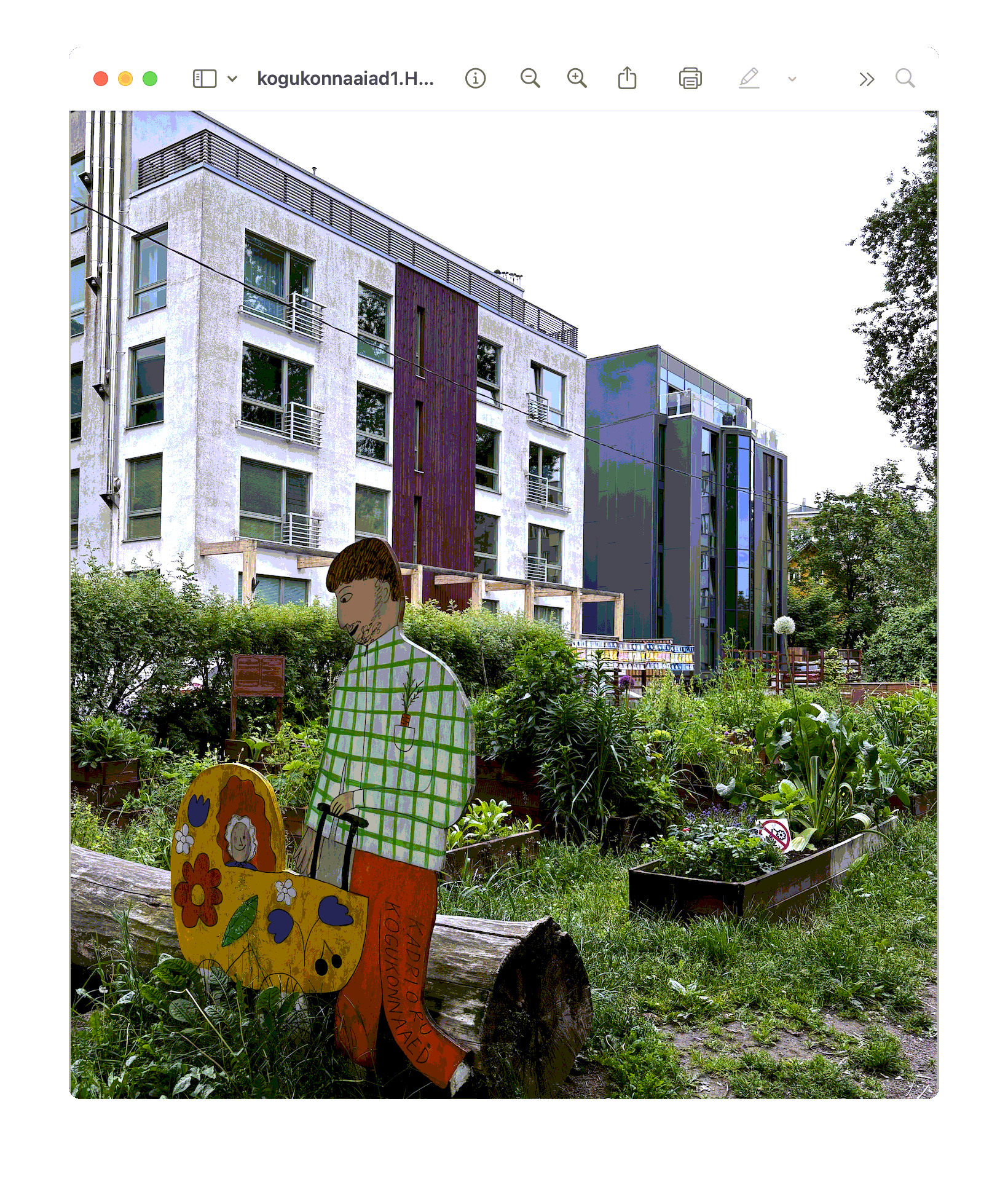
In Estonia, the most prominent movement in community gardening has been the rise of urban garden projects, especially in Tallinn. Since 2011, more than 30 community gardens have been established in the capital — now nearly every district has one. The largest community garden in Estonia, however, is located in Tartu.
Participation is simple: anyone can rent a plot and start growing their own plants. Regular workshops and educational events make these gardens not only places for gardening but also vibrant spaces for networking and community building.
Participation is simple: anyone can rent a plot and start growing their own plants. Regular workshops and educational events make these gardens not only places for gardening but also vibrant spaces for networking and community building.
“Teeme Ära” clean-up events across Estonia
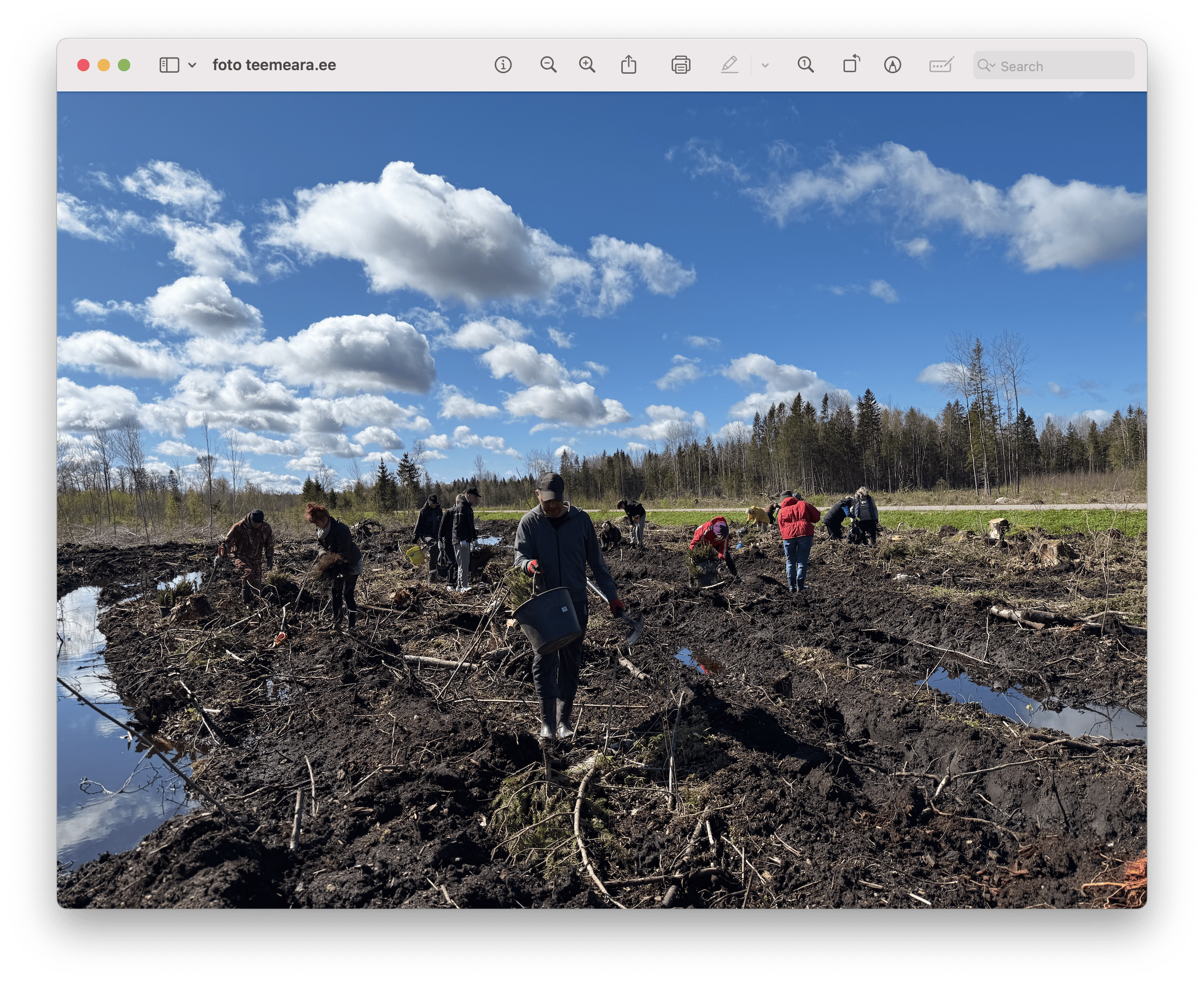
For more than 15 years, the Teeme Ära organization has been bringing people together across Estonia for collective volunteer action. In 2022 alone, 1,215 clean-up events were held nationwide as part of the World Cleanup Day, with 27,902 participants taking part.
The main idea of the project is to organize regular community clean-ups open to everyone. You can join the nearest event or start your own on the official website: teemeara.ee.
The main idea of the project is to organize regular community clean-ups open to everyone. You can join the nearest event or start your own on the official website: teemeara.ee.
Translation: Jegvenia Razgonjajeva
______________
This material is part of the PERSPECTIVES 2 project – a new label for independent, constructive, and multiperspective journalism. The project is funded by the European Union. The opinions and positions expressed are those of the author(s) and do not necessarily reflect the views or positions of the European Union or the European Education and Culture Executive Agency (EACEA). The European Union and EACEA assume no responsibility for them. Learn more about PERSPECTIVES.
This material is part of the PERSPECTIVES 2 project – a new label for independent, constructive, and multiperspective journalism. The project is funded by the European Union. The opinions and positions expressed are those of the author(s) and do not necessarily reflect the views or positions of the European Union or the European Education and Culture Executive Agency (EACEA). The European Union and EACEA assume no responsibility for them. Learn more about PERSPECTIVES.
